My Private Scalping Setup Won 98.8% of Trades. Then It Hit Zero
In this post
99 wins out of 100, and still broke
This is a private scalping setup, and on paper it's every scalper's dream. It takes a tiny, fixed profit, it almost never takes a loss, and a trade usually lasts minutes.
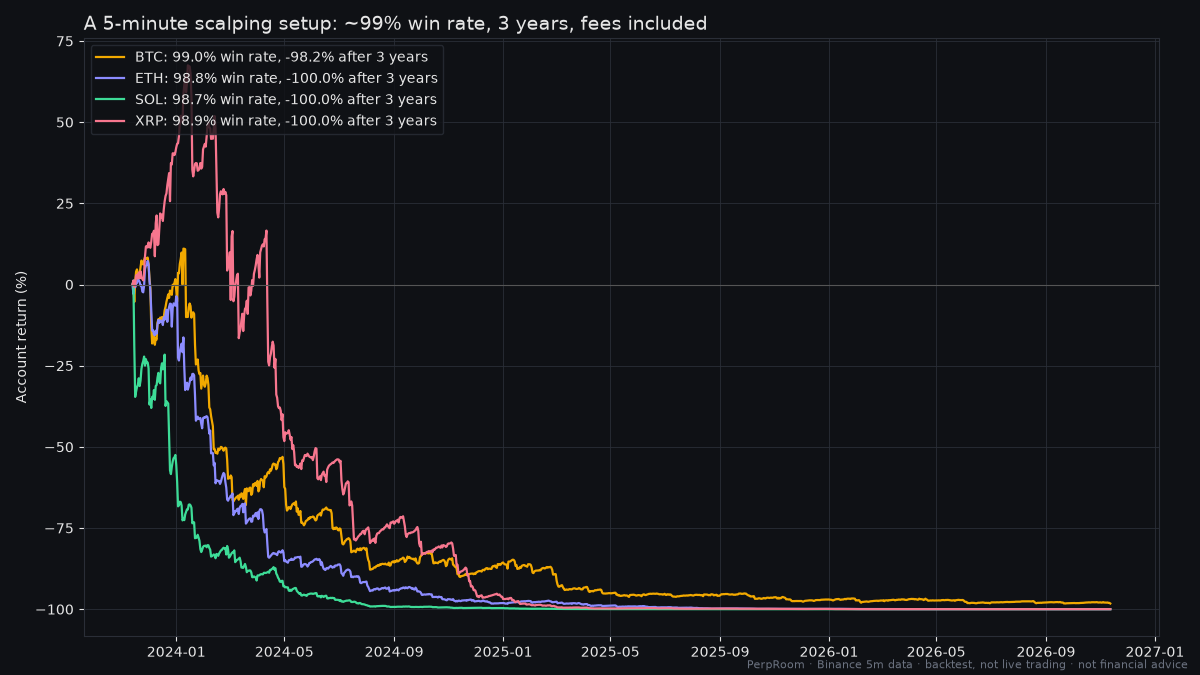
We backtested it on three years of 5-minute Binance data for BTC, ETH, SOL and XRP. The win rate held up: 98.7% to 99.0% across all four coins. More than twenty-five thousand trades in total.
The account didn't. After three years, BTC was down 98.2%. ETH, SOL and XRP were at -100.0%.
What kind of setup this is
The exact rules and settings stay members-only, but here's the shape of it so you can recognise it:
- A short-timeframe mean reversion scalper on 5-minute candles.
- It enters on a stretched move and takes a small fixed profit, measured in a few ticks.
- When price keeps going against it, it adds to the position instead of cutting it.
- It only exits a loser at a large account-level stop, and stops trading for the day after one.
- Limit orders in and out, so maker fees, with a market order on the stop.
If you've ever run anything like that, the table below is worth a minute.
Three years, four coins
| Coin | Trades | Win rate | Stops hit | Account after 3 years | Max drawdown | Buy & hold |
|---|---|---|---|---|---|---|
| BTC | 4,004 | 99.0% | 40 | -98.2% | -98.5% | +95.5% |
| ETH | 6,191 | 98.8% | 75 | -100.0% | -100.0% | -2.6% |
| SOL | 8,119 | 98.7% | 105 | -100.0% | -100.0% | +54.6% |
| XRP | 7,404 | 98.9% | 83 | -100.0% | -100.0% | +57.9% |
XRP is the cruel one. It was well up in the first months. Then a handful of stops took it all back and kept going.
Why a 99% win rate can go to zero
Every win is small. Every stop is huge. That's the whole trade-off, and it's baked into the design.
A win adds a fraction of a percent. A stop takes a big, fixed chunk of the account in one go. On BTC it took 3,964 wins to build what 40 stops destroyed. On SOL, 105 stops against 8,014 wins. The win rate is real. It just doesn't matter, because the size of the losers dwarfs the size of the winners.
Adding to losers makes it worse. The trades that would have been small losses become the large ones, because the position grows right as the market proves it wrong. That's also why the win rate looks so good: most bad trades get averaged until they bounce. The few that don't bounce are the ones that end the account.
Fees chip in too. Even at maker rates, thousands of round trips cost 23.9% to 73.1% of starting capital over three years.
Lower leverage just slows it down
We re-ran it with five times less leverage. The win rate went up to 99.7% to 99.8%, and the accounts still finished at -31.2% (BTC), -73.8% (SOL), and -84.5% (ETH and XRP). Less leverage just made it die slower.
Verdict
I wouldn't run this setup as it is, on any coin. It's a textbook example of a strategy that looks perfect in a trade log and fails in an equity curve. If someone shows you a win rate without showing you the size of the losers, ask for the equity curve.
The full rules, the exact settings we tested and our own Pine code are in the members-only Vault, along with every one of those twenty-five thousand-plus trades if you want to see the stops for yourself.
This is a backtest, not live trading. Candle data, fills at our modelled prices, no slippage on the stops, no funding. Live results would likely be worse.
FAQ
Can a strategy with a 99% win rate lose money? Yes. In this backtest four coins hit win rates of 98.7% to 99.0% and lost 98.2% to 100.0% of the account, because a few large stops outweighed thousands of tiny wins.
Is scalping with averaging down profitable on crypto? Not in this test. Adding to losing positions kept the win rate high and made the rare losses big enough to wipe the account on every coin.
Does lower leverage fix it? It slows it down. With five times less leverage the accounts still lost 31.2% to 84.5% over three years.
Indicator Reality Checks more ›
🎁 Full pack (all coins, all settings) → free when you sign up through our link