Donchian Breakout Made 22% on ETH. After Fees, -3%
In this post
Breakouts work. Fees disagree.
The Donchian channel breakout is the rule the Turtle traders made famous: buy a new 20-bar high, short a new 20-bar low, ride the trend, cut it when the move fades. Simple enough that people assume it can't fail on crypto, the most trend-happy market there is.
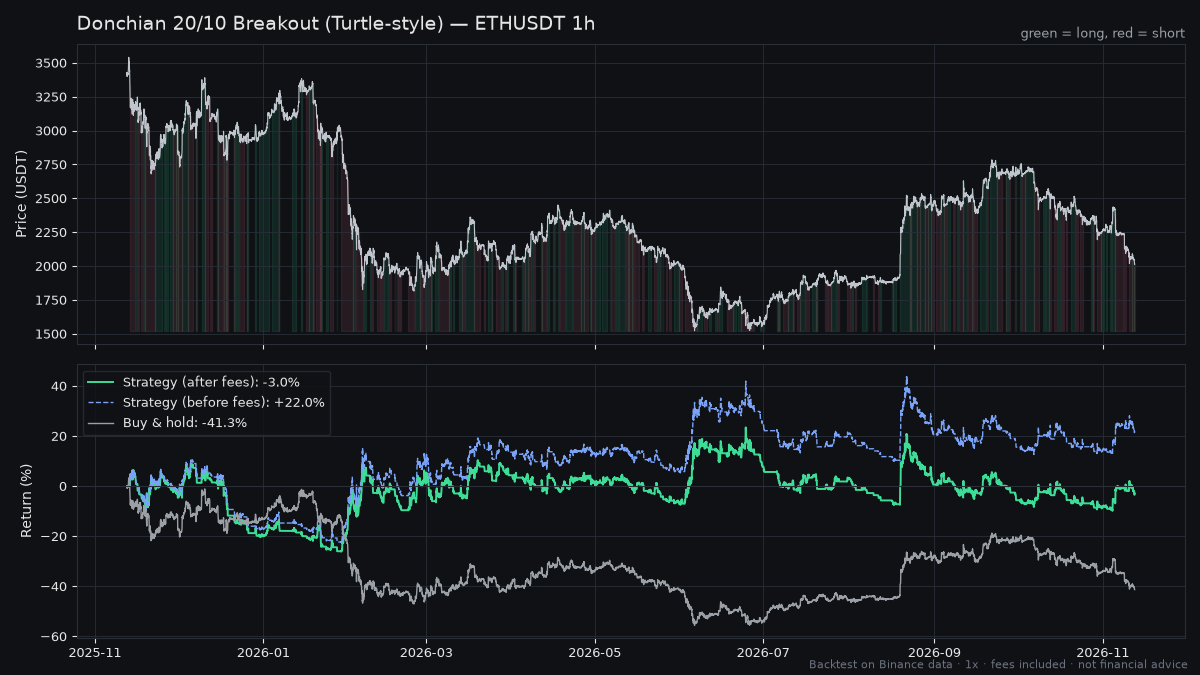
We ran a Donchian channel breakout strategy backtest on one year of Binance data for BTC, ETH and SOL on 1h and 4h candles. After fees, all six runs lost money. The best one is the most annoying: ETH 1h made +22.0% before fees and finished at -3.0% after them.
The odd part is that it still beat holding in four of six runs. That says more about the year than about the strategy.
The rules
- Entry: long when a candle closes above the previous 20-bar high. Short when it closes below the previous 20-bar low.
- Exit: close the long on a close below the previous 10-bar low, close the short on a close above the previous 10-bar high.
- Stop: 2 ATR (ATR 14) from entry, checked at the candle close.
- Costs and execution: 0.05% fee per side, 1x leverage, signals and fills at the candle close, no slippage.
- Data: Binance spot candles, 2025-11-12 to 2026-11-12.
Six runs, zero winners
| Run | Trades | Win rate | Net after fees | Before fees | Fees paid (% of capital) | Max drawdown | Buy & hold |
|---|---|---|---|---|---|---|---|
| BTC 1h | 254 | 30.7% | -24.1% | -2.1% | 25.4% | -32.4% | -29.0% |
| BTC 4h | 65 | 26.2% | -41.5% | -37.6% | 6.4% | -50.8% | -28.0% |
| ETH 1h | 228 | 31.6% | -3.0% | +22.0% | 22.8% | -32.2% | -41.3% |
| ETH 4h | 60 | 26.7% | -16.2% | -11.0% | 5.9% | -44.6% | -40.6% |
| SOL 1h | 259 | 29.3% | -48.6% | -33.3% | 25.8% | -51.6% | -47.7% |
| SOL 4h | 60 | 26.7% | -19.2% | -14.2% | 5.9% | -48.7% | -46.1% |
ETH 1h is the one to stare at. The signal had an edge before costs. Then 228 trades at 0.05% a side cost 22.8% of capital and dragged it under water.
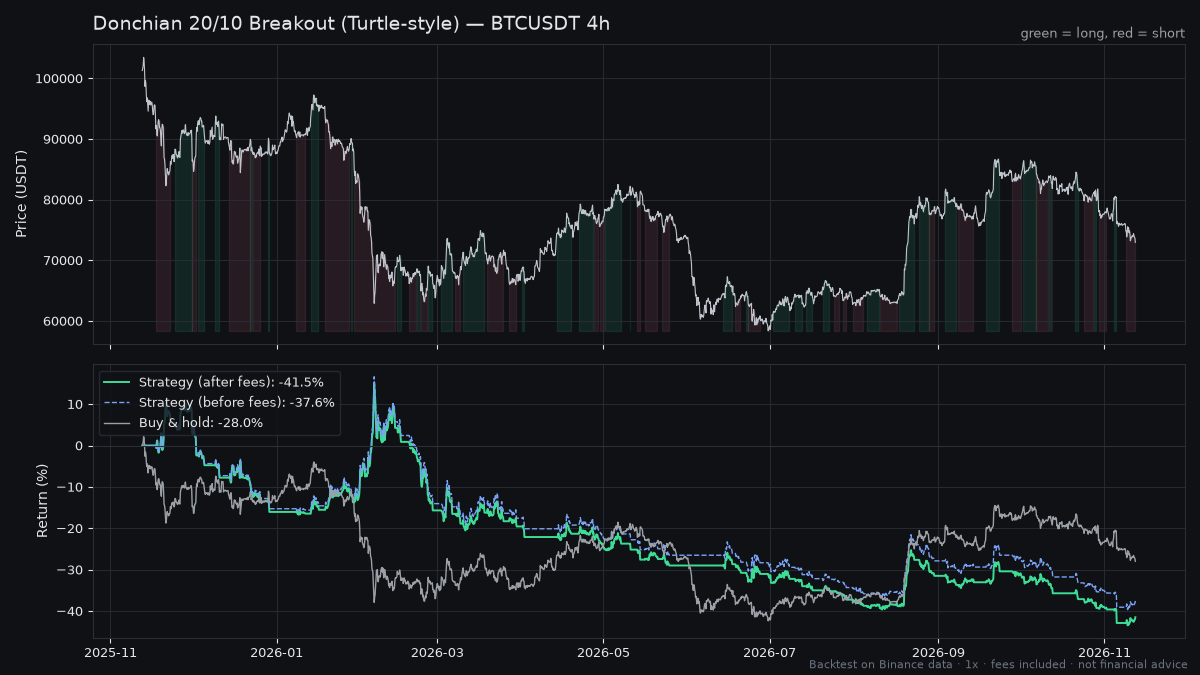
BTC 4h is the other end. Only 65 trades and 6.4% in fees, and it was already 37.6% down before fees, -41.5% after. Fees weren't the problem there. That's a strategy getting faked out over and over.
Reading the numbers
Win rate. 26.2% to 31.6%. That's normal for a breakout system and not the issue on its own. Breakouts lose small and often, and live off the few trades that run. On ETH 4h the average win was 9.09% against an average loss of 3.33%. That ratio is exactly what you want. It just wasn't enough wins to pay for the losers, and the profit factor sat at 0.99.
Fees. On 1h the fee bill ran 22.8% to 25.8% of capital in a single year. On 4h it was 5.9% to 6.4%. Same rules, roughly four times the round trips. Every breakout that fails is a full round trip, and on 1h the market prints a lot of breakouts that fail.
Versus holding. The strategy beat buy and hold on BTC 1h, ETH 1h, ETH 4h and SOL 4h. Don't read that as a win. Holding lost 28.0% to 47.7% that year, so "lost less than holding" is a low bar. It helps that a breakout system can go short when the chart falls apart, but it gave most of that back in the chop.
Drawdown. -32.2% to -51.6% at 1x. Put leverage on any of these and you're looking at liquidation, not a drawdown.
The why is the usual one for trend followers. A 20-bar breakout needs the move to keep going. Crypto trends hard for a few weeks and then ranges for months, and in a range every new high is a fakeout that reverses into your stop or your 10-bar exit. You pay the fee twice to find out.
Test it yourself on TradingView
- Open any BTC, ETH or SOL chart on the 1h or 4h timeframe.
- Open the Pine Editor, paste the script below and click "Add to chart".
- Open the Strategy Tester. The commission is already set to 0.05% per side. Compare 1h and 4h on the same coin and watch the fee line.
//@version=5
strategy("Donchian 20/10 breakout + 2 ATR stop", overlay=true, process_orders_on_close=true,
     commission_type=strategy.commission.percent, commission_value=0.05,
     default_qty_type=strategy.percent_of_equity, default_qty_value=100)

entryLen = input.int(20, "Entry channel")
exitLen  = input.int(10, "Exit channel")
stopAtr  = input.float(2.0, "Stop (ATR multiple)")

upE = ta.highest(high, entryLen)[1]
dnE = ta.lowest(low, entryLen)[1]
upX = ta.highest(high, exitLen)[1]
dnX = ta.lowest(low, exitLen)[1]
atr = ta.atr(14)

var float entryPx = na
var float risk = na

if close > upE and strategy.position_size <= 0
    strategy.entry("Long", strategy.long)
    entryPx := close
    risk := atr
if close < dnE and strategy.position_size >= 0
    strategy.entry("Short", strategy.short)
    entryPx := close
    risk := atr

if strategy.position_size > 0 and (close < dnX or close <= entryPx - stopAtr * risk)
    strategy.close("Long")
if strategy.position_size < 0 and (close > upX or close >= entryPx + stopAtr * risk)
    strategy.close("Short")

plot(upE, "20-bar high", color.teal)
plot(dnE, "20-bar low", color.red)
Your numbers won't match ours to the decimal. Data feeds and fill handling differ a little. The shape should be the same.
Verdict
I wouldn't run the plain version on 1h. The fee bill alone is a quarter of the account per year, and that's before slippage and funding, which this test doesn't model and which hit breakout entries hardest.
The frustrating bit is that the signal isn't dead. ETH 1h had a 1.05 profit factor and made money before costs. On 4h the fee bill drops to about 6% a year, which gives a filter room to work. If I wanted to rescue it, I'd move to 4h and add a filter that keeps it out of ranges, like an ADX floor or only taking breakouts in the direction of the 200 EMA. Those helped every trend follower in our fixing-indicators test. Until then, it's a fakeout collector.
FAQ
Does the Donchian channel breakout work on crypto? Not as-is in our test. All six BTC, ETH and SOL runs lost money after fees over one year, from -3.0% to -48.6%.
Is 1h or 4h better for a Donchian breakout? Neither made money. 4h paid about a quarter of the fees, but only SOL actually lost less on 4h. On 1h, fees took 22.8% to 25.8% of capital.
Why is the win rate so low? Breakout systems are built to lose small and often and win big rarely. A win rate around 30% is expected. The problem here is that the big wins didn't come often enough to cover the losses and the fees.
Breakout more ›
🎁 Full pack (all coins, all settings) → free when you sign up through our link