Binance Adds a 20x Bitcoin ETF Perp. Its Funding Cap Can Eat 120% of Your Margin a Day
In this post
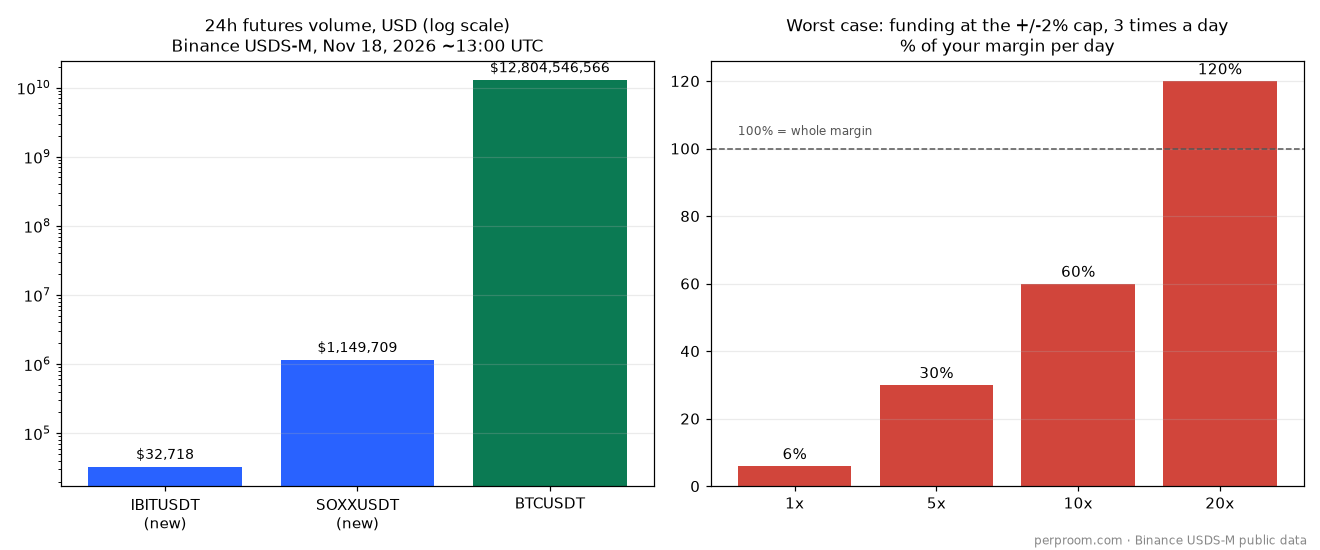
120% of your margin in one day. That is the worst case if you hold one of Binance's new TradFi perpetuals at 20x and funding sits at its cap. Binance Futures added six of them on November 18, 2026, and one tracks BlackRock's Bitcoin ETF.
What Binance listed
Six USDT-margined perpetual contracts went live between 09:30 and 09:55 UTC on November 18, according to Binance's notice:
| Contract | Tracks |
|---|---|
| SOXXUSDT | iShares Semiconductor ETF (SOXX) |
| IGVUSDT | iShares Expanded Tech-Software ETF (IGV) |
| ARTYUSDT | iShares Future AI & Tech ETF (ARTY) |
| IBITUSDT | iShares Bitcoin Trust ETF (IBIT) |
| CCJUSDT | Cameco (CCJ) |
| ETNUSDT | Eaton (ETN) |
All six share the same terms: up to 20x leverage, funding every 8 hours, funding capped at +2% / −2%, a 5 USDT minimum order, and trading 24/7. Availability depends on your region.
The number that matters: the ±2% funding cap
Funding is what longs and shorts pay each other to keep the contract price near the asset. The cap is the most a single payment can be. Most of the time funding is far below it. But if a contract gets crowded on one side, the cap is where it can go.
At the cap, you pay 2% of your position size three times a day. That is 6% of the position per day. Leverage multiplies it against your margin:
- 1x: 6% of margin per day
- 5x: 30%
- 10x: 60%
- 20x: 120%, more than the whole margin in a single day
For comparison, BTCUSDT funding was +0.0003% per 8 hours when we checked today. Our daily funding report tracks it every day.
Day one: very thin trading
We pulled Binance's public futures data at about 13:00 UTC, a few hours after launch:
- IBITUSDT: about $32,700 in 24h volume. Mark price 36.25 vs index 36.21, so the contract traded about 0.1% above the index.
- SOXXUSDT: about $1.15 million.
- BTCUSDT: about $12.8 billion.
So the Bitcoin ETF perp traded roughly 390,000 times less than plain BTCUSDT on its first day. Low volume means wider spreads and more slippage on market orders. Funding on all three was 0% or close to it.
What this means if you trade it
- IBITUSDT gives you Bitcoin exposure in a worse wrapper. It tracks an ETF that holds Bitcoin, with far less liquidity than BTCUSDT. If you just want Bitcoin, BTCUSDT is cheaper to trade.
- Use limit orders. With volume this thin, a market order can fill well away from the last price.
- Watch funding before you hold overnight. Check the next funding rate on the contract page every session. Leave a position if funding moves against you and stays there.
- Keep leverage low. At 20x, a crowded trade plus capped funding can wipe out margin even if price does not move.
- Check how the index works outside US market hours. The ETFs trade only during US sessions, while these contracts run 24/7. Read the contract details on Binance before trading weekends.
Good to know: why funding exists
A perpetual contract never expires, so nothing forces its price back to the real asset. Funding does that job. When the contract trades above the asset, longs pay shorts. When it trades below, shorts pay longs. A positive rate makes holding a long more expensive over time, even if price goes sideways.
Source: Binance Futures notice, November 18, 2026. Volume, price and funding figures come from Binance's public futures data, pulled by PerpRoom. This is news and education, not financial advice.
Crypto Futures News more ›
🎁 Full pack (all coins, all settings) → free when you sign up through our link
Compare live funding on Binance, Bybit, OKX and Bitget in $ per day: funding compare →